Now we’re going to try something that’s never been achieved before:
There’s never been 2 live government firework petitions over 100k. Let’s make this year the year it happens. To do this we need your help. So please make sure you sign and share this petition too:
Sarah Owen MP has issued an update on her Fireworks Bill:
“So what’s happening to my Fireworks Bill?
You might have noticed that the Fireworks Bill was down to be debated on 31 October 2025 – but as Parliament is not sitting, it’s been moved to a new day. We don’t know when or if it’ll get a debate – we can’t wait, so I’m carrying on the campaign. During this firework season, I have:
Kept in ongoing contact with Bedfordshire Police and Luton Council to ensure fireworks complaints are being actioned and monitored & information about firework use is distributed.
Written to supermarkets asking them to stop their shop displays promoting fireworks.
Sponsoring an event in Parliament for the Fireworks Impact Coalition, which will be on the 12th November – if you’re not in Luton North, please encourage your MP to go. This is a nationwide issue.
Secured a meeting with the new Minister responsible to get an in-person update on how fireworks legislation is being reviewed.
Working alongside animal, armed forced and mental health charities to spread the word about our campaign to limit the sale of the loudest fireworks.
It’s been over a year since I introduced my Bill to Parliament. In that time, the problem hasn’t gone away, and I know in Luton, it feels like it’s getting worse.
I continue to push for common-sense changes to our fireworks laws. To end the licensing loophole, ban the loudest from public sale & limit their use to licensed pyrotechnic professionals in organised displays.”
Fireworks cause distress and anxiety to many people and animals. This can lead to injuries and death.
The Firework Campaign has been campaigning on behalf of those adversely affected by fireworks in the UK since 2013. During this time we have heard from numerous human and animal charities about how fireworks affect their members.
Some of the bigger charities have now come together to form the Firework Impact Coalition to ask the government for legislation reform read more …
If you run a charity, not for profit organisation or business
We Want Your Voice To Be Heard
Introducing The Association for Firework Legislation Reform (AFLR). Our mission is to gather support from the wide range of charities, organisations, groups and individuals who are all, in one way or another, negatively affected by the extreme overuse of fireworks today. We hope to improve the welfare of vulnerable members of society, as well as domestic, agricultural and wild animals, whilst balancing people’s right to enjoy fireworks read more …
We ask for nothing more than your endorsement and would love to add your organisation to the growing list of supporters.
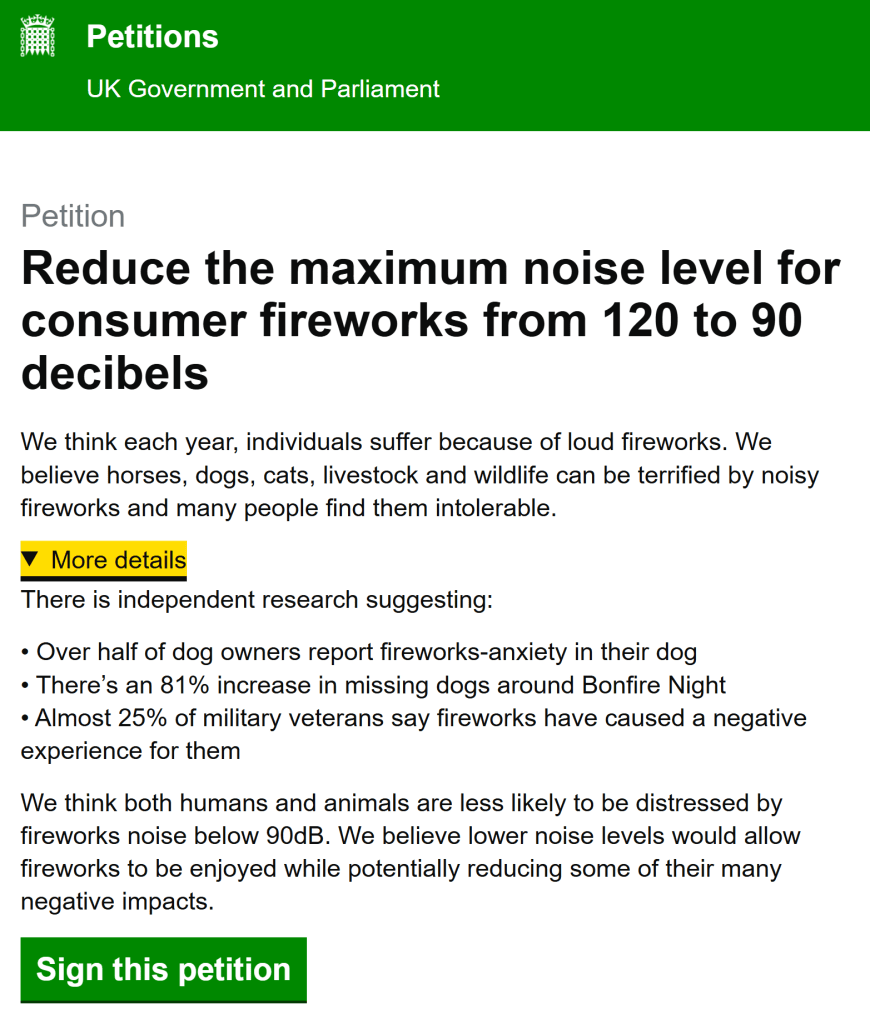
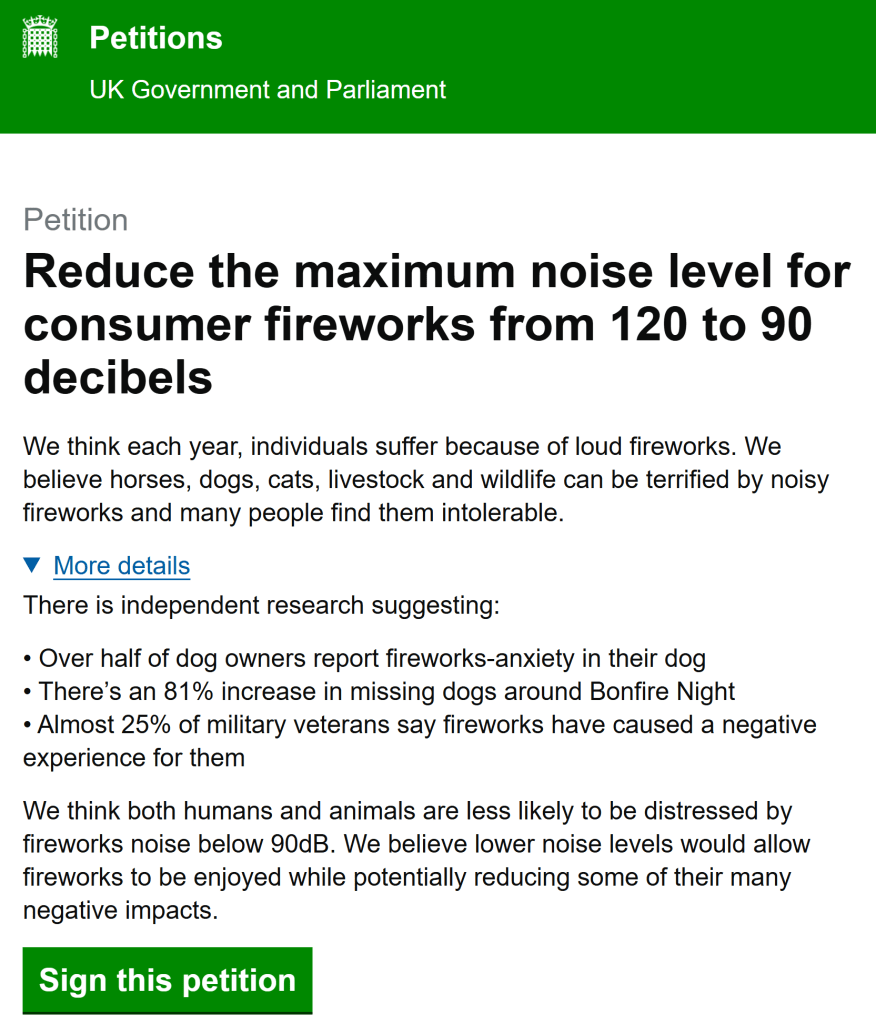
“With more than 45,000 people having signed our petition in just seven weeks, we know that there is enormous public support for Redwings’ call to simply reduce the maximum noise level of fireworks from 120 decibels to 90 decibels.
All petitions that achieve 10,000 responses receive a government response and we have now received that response. Everyone who has already signed the petition should have been sent an email notification with the government’s statement.
Redwings is disappointed but unsurprised to read that at this stage the government is continuing to focus on the need to promote responsible use of fireworks within current regulations.
Unfortunately, we believe that this approach is ineffective and places an impractical burden on firework users themselves to fully understand the multiple negative impacts a single display may have and make fully informed decisions as a result.
Loud fireworks can cause significant distress to horses, dogs, cats, other pets, livestock, military veterans, people living with PTSD, sensory issues such as autism or neuromuscular conditions such as cerebral palsy. Without knowledge of every person and animal in the vicinity of a planned display and how fireworks may affect them, we do not think it is possible for organisers to prevent possible harm.
While we welcome the government’s efforts to raise awareness of the potential impact of fireworks, we don’t feel the messages are strong or clear enough to adequately convey the level of risk even legal use of fireworks involves and how important it is that those considering using fireworks take steps to mitigate those risks. We are also unsure that these messages will reach enough people to make a difference.
We feel strongly that by only making low-noise fireworks available to the public, far greater protection from distress to animals, people and wildlife is achieved, while allowing those who wish to use fireworks to celebrate to do so.
We welcome the government’s commitment to engaging with charities like Redwings and other organisations who are calling for better regulation of fireworks. We have already shared evidence of the impact fireworks can have on horses and their owners through our Fireworks and Horses survey report and attended a meeting with the Department of Business and Trade earlier this year. We have also shown that the Animal Welfare Act does not offer adequate protection against incidences of inadvertent suffering to animals caused by fireworks in our ground-breaking report published in 2024.
As the evidence and support for regulatory change continue to increase, it is becoming notably harder for the government to avoid meaningful action on this issue. On reaching 100,000 petition signatures we are confident of triggering a parliamentary debate which will provide an opportunity to engage in more detail on the many reasons why there is no longer a place for excessively loud fireworks in our inclusive and animal-loving society.
If you haven’t already signed the petition, please add your name today and share as widely as you can to help us achieve our 100,000 signature target. Thank you.”
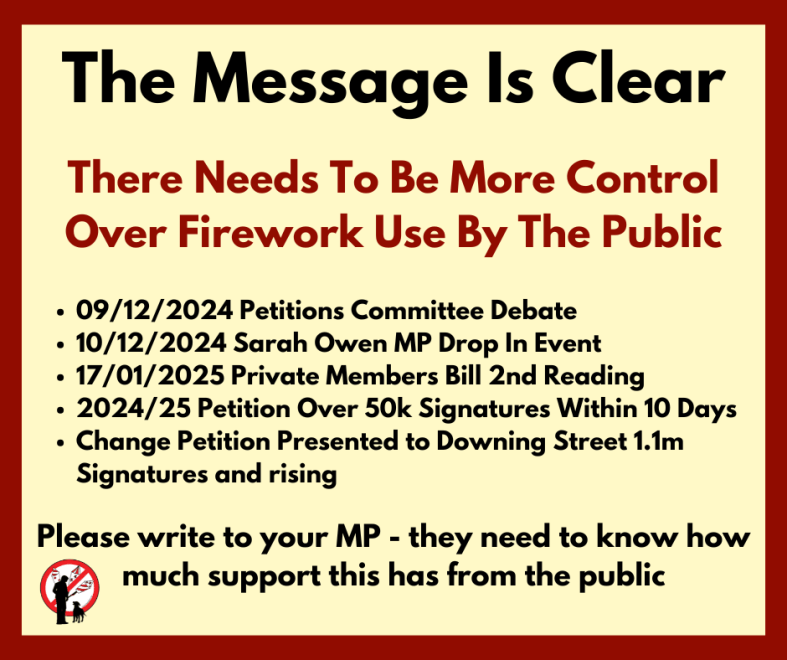
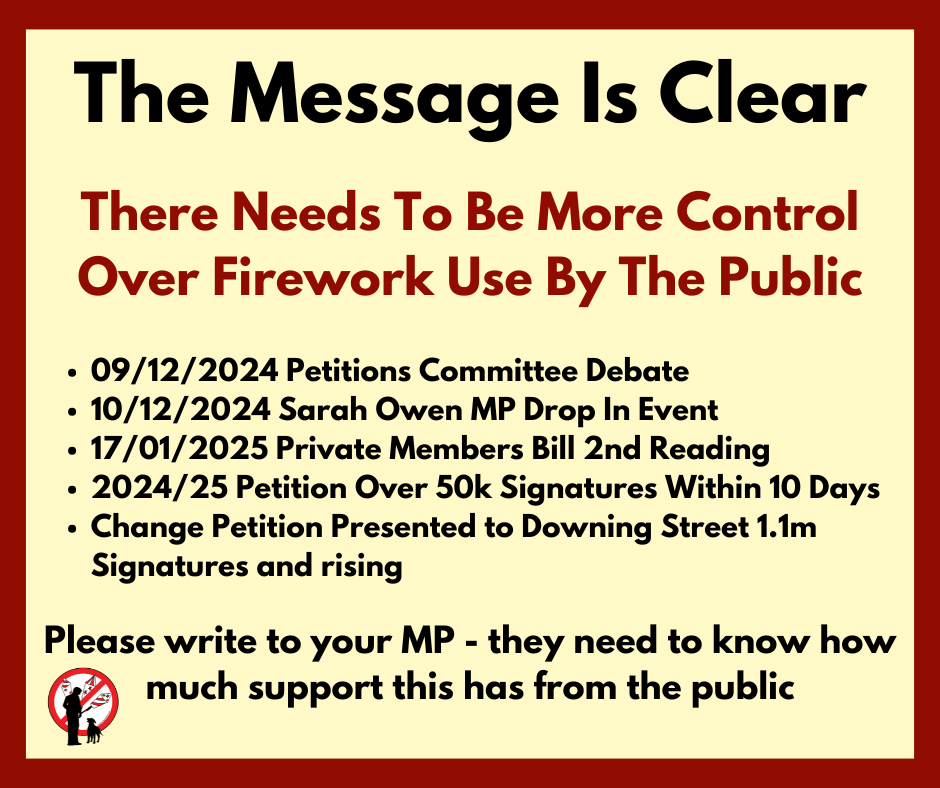
On 9th December the 2023 government petition on fireworks will be debated in Westminster Hall, offering a critical opportunity to influence future regulations
On 10th December, Sarah Owen’s MP drop-in event will provide a platform for MPs to understand the importance of firework reform and its public backing
On 17th January, Sarah Owen’s private members’ bill will have its second reading
Combined with the 1 million+ supporters of our change petition and the current government petition over 50,000 signatures in 10 days, this is our best chance to show MPs how much public support exists for stricter regulations
Fireworks cause significant harm to pets, wildlife, the environment and people with conditions affected by fireworks. Emailing your MP is a key step toward pushing for better regulations. Some people have suggested a template they can use to email their MP, but unfortunately, it is likely such an email would be rejected as it would be identified as a duplicate or spam. Writing your message in your own words makes it far more likely to be noticed and taken seriously.
In order to help, we have included below some points to consider, which can be used as a guideline:
1. Introduce your concern:
– Example: “I am writing to share my concerns about the significant harm caused by the widespread use of fireworks in our community.”
2. Share your personal experience (optional but beneficial if you can):
– Briefly explain how fireworks affect you, your family, or your pets.
– Example: “Every year, my dog suffers severe anxiety due to fireworks, requiring sedation for weeks.”
3. Highlight the wider impact:
– Mention the effects on wildlife, farm animals, or vulnerable individuals such as those with PTSD, dementia, or neurodivergent conditions such as autism.
– Include environmental concerns, such as pollution from chemicals and debris.
4. Propose solutions:
– Suggest restricting fireworks to licensed, organised events only.
– Call for designated firework dates to limit prolonged distress.
– Example: “I urge you to advocate for stricter regulations on fireworks and raise this issue in Parliament.”
– Ask them to attend the debate on 9th December.
– Ask them to attend Sarah Owen’s MP drop-in event on 10th December, where MPs can learn more about her private members’ bill on firework reform and the widespread public support for these changes.
– Ask them to support the second reading of Sarah Owen’s private members bill on 17th January.
6. Be polite and concise:
– Example: “Thank you for taking the time to consider my concerns. I hope you will support changes to address this issue.”
Always remember to add your full name, address, phone number, and email address, otherwise your email may be ignored.
You might have noticed we look a bit different today – very different in fact! In our 200th year we’re proud to unveil a bold new look and feel for our historic charity. A new brand along with a new purpose – inspiring everyone to create a better world for every animal. In shorthand, people will see us talking about For Every Kind. That means for every kind of animal, whether it’s helping thousands through our vital rescue work, or helping millions more through our advocacy, prevention and education work, both here and around the world. But it also means for every person, whoever they are, because we need everyone to get involved in animal welfare.
In the 200 years since we were founded, we’ve changed attitudes, behaviours and laws towards animals and, as a society, we’ve revolutionised the way we think, feel and act towards them. But animals are now facing some of the biggest challenges in our 200-year history, from climate change to loss of habitat, intensive farming to the cost of living crisis. Unless we act urgently to put animal welfare back on the agenda as one of the most pressing issues of our time, we risk animals’ lives getting worse, not better.
We at the RSPCA have a critical role to play as the oldest and biggest animal charity in the country; with our powerful voice, we can bring individuals and organisations together to drive change. We know we can’t do it alone, which is where our new, brighter, bolder and more welcoming brand comes in.
We’re proud of our 200 year history, and we’ve achieved a lot, including changing more than 400 laws improving the lives of animals in labs, in farms, in homes and in the wild. But we have changed too and we know that, for many people, our old brand was out-of-date or off putting. We haven’t rebranded since the 1970s and it was holding us back from being the modern, forward-facing organisation we really want, and need, to be.
It isn’t just about a new logo, this is all about raising the profile of animal welfare and helping everyone understand that we can all play a part in improving animals’ lives. Our new brand will help us reach more people, people who may not have considered us, or their role in animal welfare, before. We want to build a movement for animals and the more people we can inspire to get involved, the more impact we can have for animals, now and for many years to come.
We’re at a turning point and we’re changing to meet the challenges ahead. We need as many people as possible to join us to create a better world for every animal. Because a world that’s better for animals is better for us all.
10 years ago Julie started a petition with a couple of really good friends asking the UK Government to limit firework use. That petition, after a lot of hard work and even more FABulous friends, eventually morphed into The Firework Campaign.
The Firework Campaign has had success pushing 6 petitions over 100,000 signatures and following those were 5 debates in Westminster Hall, Parliament. Our current petition will be taken to No 10 this year. As we have been constantly disappointed with the response from Government to the government petitions and the debates we have been looking for ‘another way’.
At the same time charities have been searching for ways to bring this issue to the Government’s notice and a group of 17 charities have come together to form The Firework Working Group (FWG).
Going forward we have created The Association for Firework Legislation Reform (AFLR). This new UK based organisation will support the FWG to help them achieve a change in the 20 year old Fireworks Regulations 2004. Our mission is to gather support from a wide range of charities, organisations and groups who are all, in one way or another, negatively affected by the extreme overuse of fireworks today. We hope to improve the welfare of vulnerable members of society, as well as domestic, agricultural and wild animals, whilst balancing people’s right to enjoy fireworks. To this end we also continue to support the RSPCA’s Bang Out Of Order Campaign.
Add your organisation’s support by completing the form.
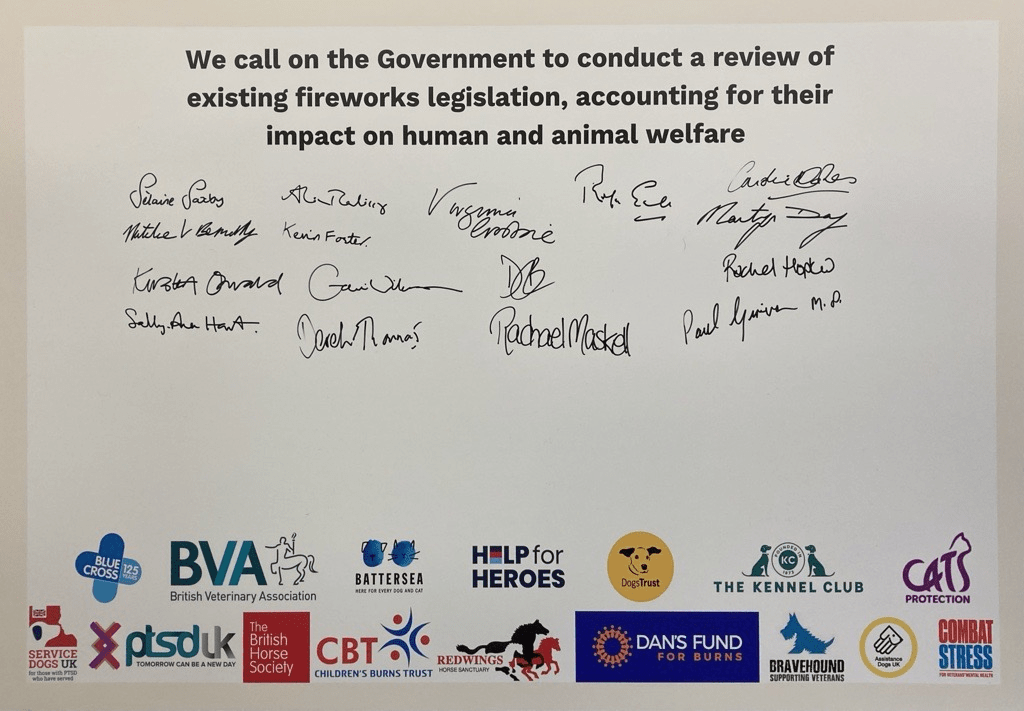
On December 6th 2023 a group of charities welcomed MPs to a coalition event to discuss how firework legislation is failing the vulnerable in our society. Humans and animal welfare suffers when fireworks are used sporadically throughout the year.
The event was hosted by the ‘Fireworks coalition’ consisting of: Combat Stress, Help for Heroes, Dogs Trust, Blue Cross, Battersea, British Veterinary Association, Cats Protection, Children’s Burns Trust, The Kennel Club, PTSD UK, Dan’s Fund for Burns, Assistance Dogs, Service Dogs, The British Horse Society, Redwings and Bravehounds.
The message from every charity was clear. The government needs to introduce tougher restrictions on firework use.“We call on the UK government to conduct a review of existing fireworks legislation accounting for their impact on human and animal welfare.”
The gold nugget to take from this is that the ‘human’ charities have joined with the animal charities. Stronger together.
The Firework Campaign is working closely with the BHS, RSPCA and Redwings.
We will keep you up to date with more from the Firework Working Group as it happens.
On New Years day my horse of a lifetime and best friend Talullah, who I had owned for 18 years, had to be put to sleep. This was a direct result of our neighbours letting off fireworks close by.
Talullah was usually reasonably calm with fireworks. Combined with the terrible weather that night, we thought that the risk of random unplanned displays would be minimised. However, we couldn’t have predicted what fireworks people choose to let off.
Tragically what was let off on New Years Eve was so terrifying to her that she ran blindly straight through a solid wooden fence. She came to a stop on a local road. The police attended and closed the road and called the emergency vet. I got to the scene (with my children in the car) to find my horse lying on the road. A horrific scene that I will never be able to forget.
With the help of a vet and police escorts, we managed to get Talullah up and home.
We tried to get her stable comfortable (sedated, painkillers, fluids and a rectal exam), as for a while we were hopeful that she might get through the shock, potential internal injuries and the colic that was caused by her terror.
By 1pm on New Years day she was seriously ill and was suffering. Despite the highest level of pain relief having been administered, Talullah was still in horrific pain and was shaking, dripping with sweat, falling over, and showing a heart rate of 120.
Under the vet’s guidance l did the only thing that I could for her and made her pain end, she was euthanised.
My horse of a lifetime is dead and suffered a horrific painful death and a massive vet bill. I can’t stop thinking about what I saw and how she suffered so horrendously, I keep seeing flashbacks, all so people can enjoy fireworks at home.
I am sorry to say it but this unnecessary suffering was a direct result of people setting off fireworks in their back gardens.
I completely understand that some people will have absolutely no idea of the potential damage and suffering that fireworks can cause, so my aim is to help those people to get a better understanding of the problem and explain why we have got to put a stop to the excessive use of fireworks near livestock.
“The Animal Welfare Act 2006 states it is an offence to cause any unnecessary suffering to any captive or domestic animal. Government advice is – Fireworks must not be set off near livestock or horses in fields or close to buildings housing livestock”
Furthermore “Section 4 of the AWA 2006 says
(1) A person commits an offence if—
(a) an act of his, or a failure of his to act, causes an animal to suffer,
(d) the suffering is unnecessary.”
The offence carries a fine of up to £20,000 and/or a prison term of up to six months. The Act is enforced by local councils, animal health officers and the Police.
We all totally understand that people want to enjoy fireworks, but was it really worth the pain and suffering that it has caused, just to have them at home?
In future, I beg you to please consider going to a well publicised, organised display, instead of doing one at home. There are so many displays at various times of the year for different religions and celebrations. Most of them are organised to raise money for a charity which is even better.
My heart is broken, we have lost our very much loved family pet, my horse of a lifetime gone forever for someone’s few minutes of gratification.
For the sake of the other animals and livestock, please can we come together to make sure no other animals suffer a horrific tragic death like my best friend Talullah did.
People can do better than this!
Some notes to help people understand and provide some insight as to the realities of fireworks and horses:
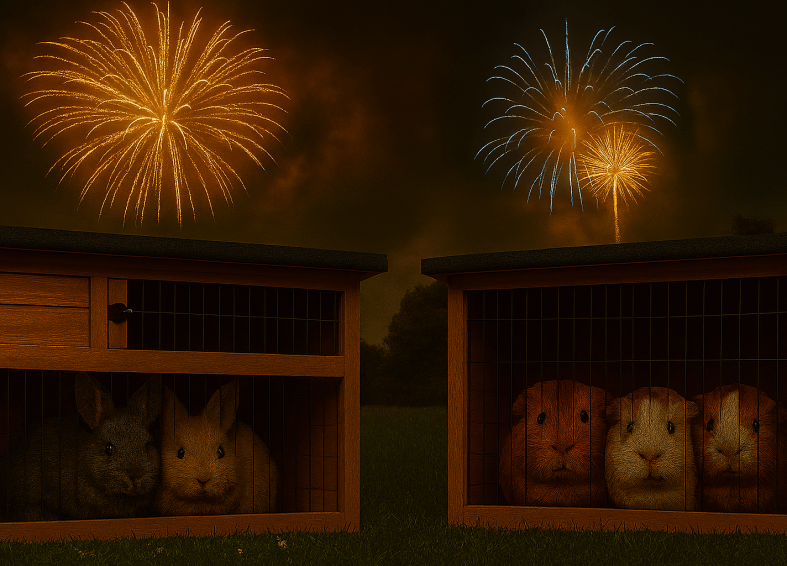
*As prey animals, horses have a heightened sense of awareness, highly sensitive to loud noises, strange smells and flashing lights. Naturally, their instinct is to flee when they sense danger.
*Even the calmest of horses can become extremely unsettled. When something is upsetting to horses or causes discomfort, the adrenal glands release a hormone called cortisol. Also known as the ‘stress hormone’, this prepares their body to react, resulting in significant and often dangerous behaviour changes.
*Stress in horses can very quickly cause serious digestive issues which lead to Colic. Colic is a serious, extremely painful condition that is frequently fatal.
*A horse will cope best in a familiar environment, keeping to his or her normal routine. So if it lives out, stay out. If it lives in a stable to stay in. Not all horses cope with living in a stable or being confined, for some being confined increases their distress.
*Sedatives can be purchased from a vet in advance, during working hours. This does not include weekends and bank holidays. The cost is typically around £50 for the stronger doses. Sedation only works for a set length of time and must be given in advance of the planned upset, or there is a risk that the horse’s adrenaline will override the sedation.
*Sedation is not something that is suitable for all horses due to age and other health conditions.
If you are considering having a display at home, please, please, please just stop and evaluate if it is really worth it?
If you got this far, thank you so much. Joanna Barnett
Please take a look at the following links. We are all desperate for the unnecessary suffering to stop. Please support
THE FIREWORK CAMPAIGN.
Editors note: What a terrible start to 2023 for Joanna, sadly Talullah is not the first, and even worse….she won’t be the last.
Please support our campaign to stop firework sales to the general public and keep them to well-advertised licensed displays.
A new registration scheme is being considered by North East Derbyshire District Council. In an attempt to regulate firework use they are asking the public to register if they are planning to use fireworks. It obviously won’t do anything to combat ‘misuse’, it might however help notify people and pet owners of the random and unexpected use by the public. Most community and local events are amply advertised for the revenue. So this a small step in the right direction. Please find time to thank the council for their forward thinking.
Their facebook posts says, “NEDDC is putting together plans to introduce a voluntary Bonfire and Firework Display Registration Scheme to combat the misuse of fireworks and safely regulate those attending bonfire events and wishing to let off fireworks in the District.”





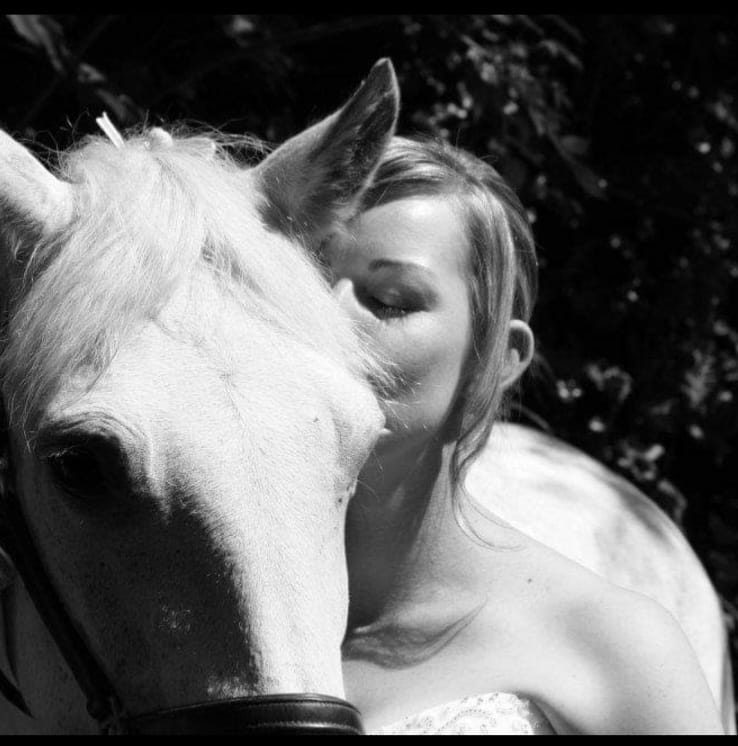

 Joanna Barnett
 The Firework Campaign UK