Your Dog’s Fear Of Fireworks Is Not Your Fault

Credit Holly Leake, Paw Chores

With sincere thanks to Holly Leake of Paw Chores for allowing us to reproduce her content here

I am really tired of the hurtful comments directed at those who have dogs with a fear of fireworks. There are so many accusing dog guardians of neglecting to socialise and train their dog or they are insinuating it is the guardian’s response to the fireworks that makes the dog so afraid. This is despite the fact that dogs (and other animals) across the UK are having heart attacks, seizures and strokes, some of which have been fatal. How can a dog guardian’s response to fireworks possibly elicit such an extreme reaction to fireworks?

And if this is the cause of such extreme fear, what accounts for the deaths of wildlife and farm animals? Are there people ‘coddling’ them too? Let’s not forget dogs in rescue shelters. If it’s our response that creates this fear, then why do rescue dogs show extreme anxiety and try to escape their kennels? They are in there alone most of the time. Such heartless comments are baseless since studies show that there are many factors that contribute to noise sensitivity and a fear of fireworks, as seen below.

Genetics

A study involving over 13,700 dogs in Finland discovered that around 32% of dogs had sound sensitivities and 26% were afraid of fireworks. The scientists in this study also identified a genetic predisposition to a fear of fireworks (Salonen, M. 2020) Blackwell et al. (2013) discovered that twelve breeds or breed types were less likely to show fear responses to noises than cross-breeds and their data suggest that some breeds may be predisposed to fear of loud noises, including fireworks.( Linn Mari Storengen, Frode Lingaas 2015.) Thus, your dog may be afraid of fireworks, due to their genetics.

Pain & health conditions

A study showed that dogs that experienced muscle or bone pain were more sensitive to sudden noises, loud noises and different pitches than dogs who were noise-sensitive but didn’t have pain. (Lopes Fagundes 2018) The same study found that the average age of onset for noise sensitivity in dogs differed between groups. In clinical cases (with pain), the average onset of noise sensitivity was 5 years and 7 months.

“Although the average ages of the dogs at presentation were similar, the average age of onset of the problem was nearly 4 years later in the “clinical cases.” This strong theme of an older age of onset suggests that the pain may develop later in life and that owners seek treatment more readily, perhaps because the appearance of the problem is out of character in the subject. The average age of onset within the control population also suggests that the problem does not simply relate to a lack of habituation as a puppy and that other mechanisms need to be considered for many cases.” (Lopes Fagundes 2018)

Other health conditions can also trigger noise phobias. Conditions such as endocrine diseases, cardiopulmonary disease, neurological problems, and cognitive dysfunction, can potentially contribute to or exacerbate behavioural problems including noise fears. (Bowen J. 2008) So both pain and health conditions can cause a fear of fireworks.

Age

Studies show that fearfulness is most common in dogs aged 4-8 years and that noise sensitivity often increases with age., ( Milla Salonen 2020) Another study that supports this shows that the average age of onset of noise phobias developed around 4 years 7 months of age. Dogs progressing through adolescence also go through a second fear period from around 10-12 months of age. At this time of development, dogs can develop new fears and phobias, including noises like fireworks. As a dog reaches their senior years, ill health and conditions such as cognitive dysfunction disorder (dog dementia) can also cause anxiety, fear-related behaviours and noise sensitivities.

Anxiety

Studies show that dogs most fearful of noises also presented with a higher chance of separation-related anxiety and being fearful in novel situations. These dogs also took much longer to decompress after a stressful event compared to dogs less fearful of noises. (Linn Mari Storengen, Frode Lingaas 2015.) It makes sense that if your dog is already struggling with anxiety, that they are more likely to develop noise phobias.

Survival Instinct

“An extreme avoidance response to a loud firework going off unexpectedly nearby, given the salience of this event and its unpredictability for the animal, can be interpreted as adaptive (‘rational’), an argument which has also been applied to extreme fear responses in humans”. (Davey, 1995) From a survival point of view, it is logical for dogs and other animals to respond in fear to explosions. Why wouldn’t they? They can’t reason that it’s harmless.

It should be noted that studies have found that dogs that attend training classes are less likely to be afraid of fireworks however, it is unknown why this would be the case, as exposure to fireworks sounds is not usually part of the curriculum.

Many dogs have been desensitized to fireworks as puppies and have been adequately trained and socialized, and yet they still develop a fear of fireworks. The fact that dogs don’t develop this fear until around the age of 4 proves that often the fear is due to over-exposure, trauma, anxiety or health issues. If it was solely due to a lack of training or due to the dog guardians’ response to the fear, we would likely see the phobia developing much earlier in the dog’s life.

Therefore, it is hurtful and completely speculative to blame guardians for a dog’s phobia of fireworks. The real blame rests on the shoulders of those who continue to set off loud fireworks, knowing for well the suffering it causes to dogs, pets, wildlife, and even people. – Holly Leake

Huge thanks to my friends at Canine Principles for their help finding studies on the subject. ❤️🐾

References

Bowen J. Firework Fears and Phobias. UK Vet Companion Anim. 2008;13:59–63. doi: 10.1111/j.2344-3862.2008.tb00529.x. [DOI] [Google Scholar]

Camps T., Amat M., Manteca X. A Review of Medical Conditions and Behavioral Problems in Dogs and Cats. Animals. 2019;9:1133. doi: 10.3390/ani9121133. [DOI] [PMC free article] [PubMed] [Google Scholar

Lopes Fagundes AL, Hewison L, McPeake KJ, Zulch H, Mills DS. Noise Sensitivities in Dogs: An Exploration of Signs in Dogs with and without Musculoskeletal Pain Using Qualitative Content Analysis. Front Vet Sci. 2018 Feb 13;5:17. doi: 10.3389/fvets.2018.00017. PMID: 29487858; PMCID: PMC5816950.

Linn Mari Storengen, Frode Lingaas 2015. Noise sensitivity in 17 dog breeds: Prevalence, breed risk and correlation with fear in other situations Applied Animal Behaviour Science

Volume 171, October 2015, Pages 152-160 https://doi.org/10.1016/j.applanim.2015.08.020

Salonen, M., Sulkama, S., Mikkola, S. et al. Prevalence, comorbidity, and breed differences in canine anxiety in 13,700 Finnish pet dogs. Sci Rep 10, 2962 (2020). https://doi.org/10.1038/s41598-020-59837-z
Why now is the perfect time to email your MP

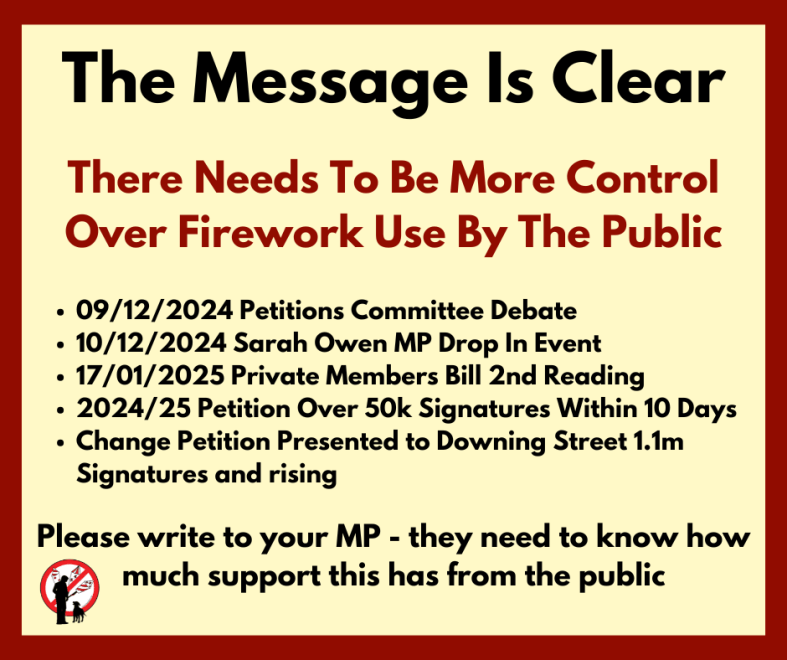
  • On 9th December the 2023 government petition on fireworks will be debated in Westminster Hall, offering a critical opportunity to influence future regulations
  • On 10th December, Sarah Owen’s MP drop-in event will provide a platform for MPs to understand the importance of firework reform and its public backing
  • On 17th January, Sarah Owen’s private members’ bill will have its second reading
  • Combined with the 1 million+ supporters of our change petition and the current government petition over 50,000 signatures in 10 days, this is our best chance to show MPs how much public support exists for stricter regulations

Fireworks cause significant harm to pets, wildlife, the environment and people with conditions affected by fireworks. Emailing your MP is a key step toward pushing for better regulations. Some people have suggested a template they can use to email their MP, but unfortunately, it is likely such an email would be rejected as it would be identified as a duplicate or spam. Writing your message in your own words makes it far more likely to be noticed and taken seriously.

The easiest way to contact your MP is to use https://www.writetothem.com/

In order to help, we have included below some points to consider, which can be used as a guideline:

1. Introduce your concern:

– Example: “I am writing to share my concerns about the significant harm caused by the widespread use of fireworks in our community.”

2. Share your personal experience (optional but beneficial if you can):

– Briefly explain how fireworks affect you, your family, or your pets.

– Example: “Every year, my dog suffers severe anxiety due to fireworks, requiring sedation for weeks.”

3. Highlight the wider impact:

– Mention the effects on wildlife, farm animals, or vulnerable individuals such as those with PTSD, dementia, or neurodivergent conditions such as autism.

– Include environmental concerns, such as pollution from chemicals and debris.

4. Propose solutions:

– Suggest restricting fireworks to licensed, organised events only.

– Call for designated firework dates to limit prolonged distress.

– Have a look at the Firework Campaign website and our petitions calling for action 

5. Request action:

– Example: “I urge you to advocate for stricter regulations on fireworks and raise this issue in Parliament.”

– Ask them to attend the debate on 9th December.

– Ask them to attend Sarah Owen’s MP drop-in event on 10th December, where MPs can learn more about her private members’ bill on firework reform and the widespread public support for these changes.

– Ask them to support the second reading of Sarah Owen’s private members bill on 17th January.

6. Be polite and concise:

– Example: “Thank you for taking the time to consider my concerns. I hope you will support changes to address this issue.”

Always remember to add your full name, address, phone number, and email address, otherwise your email may be ignored.

Tragic and senseless loss

From one of our members in Wales…..

So very sad. We lost our loyal and beloved Bella last night. She died because of the  New Years fireworks in our village. She was in the house with my son, TV was on full volume, curtains closed. We knew she hated fireworks, but not enough to sedate her,  so I thought. This time, as soon as she heard the fireworks she first hid behind the TV and then she came out and fell down by my son’s side and was dead.

He phoned me at 12.08 am, I ran home nothing could be done, she had no symptoms of heart problems, she was running in the field at 6.30pm happy as usual.

We are devastated to have lost her in this frightening way. Such a shame and it was all because of fireworks.

Bella was only 5yrs old and was a lifeline for my son who suffers from depression, his best friend.

I am hoping all fireworks will be banned or even if they used ones with less noise, it would help our beloved pets.       … Ann

Beautiful, loyal, trustworthy, fun, happy Bella.  Someones best friend……

15841508_10154924899202612_636900062_n

SIGN HERE please to help FAB stop random fireworks. Read our HOME PAGE to see what we are about…

Please report every incidence of fireworks you hear on our FIREWORK LOG. We are collecting data to prove to the government that random fireworks do occur……They insist fireworks are mostly limited to traditional dates already. We know that is not the case.

Please WRITE TO YOUR MP and let them know how you feel.. If you don’t tell them they will continue to deny the problem.

FAB are asking the government to restrict public USE of fireworks to traditional dates. That works out about 10 days a year. So you can still have them in your gardens around Guy Fawkes and New Year, Diwali and Chinese New Year.. There will still be displays and fireworks competitions as there are now, just no random unexpected fireworks to frighten people and animals.

#fabuk

‘VETS NOW’ ARE SUPPORTING CALL FOR ‘SILENT FIREWORKS’ AT ALL NEW YEARS EVENTS

NB 29/10/20 FAB firework campaign is aware that ‘silent’ fireworks do not exist.. Quieter fireworks are sold in all major supermarkets except Sainsburys who for the second year have decided not to sell fireworks at all, and the Co op who have never sold them.

Silent fireworks are a marketing ploy.

——————————————————————————————————————

Vets at the UK’s leading provider of pet emergency care are calling for quiet fireworks at all New Year’s Eve celebrations.

Why not email Amanda Boag, ‘Vets Now’ Clinical Director at ‘Vets Now’  on  marketing@vets-now.com and let them know how you feel about fireworks

Please click HERE to read the whole story

Only 12 days to go

,

Only 12 days until it starts to get lighter….

Not that it will stop the NYE fireworks!

Sign the petition please here ….HELP FAB stop random fireworks. Follow us on fb,  twitter pintrest, you tube.

Happy Christmas everyone, hope all your animals stay sane and safe over New Year.

10 year old Tyler Walker

By Cheyenne Roundtree, Chronicle Live 30 OCT 2016

Meet the schoolboy who has launched an appeal to ban fireworks because of the danger they pose to animals.

Tyler Walker, 10, was left devastated after finding the body of missing dog, Shearer, washed up on the beach’s shore on 23 October.

The dog had been at the centre of a region-wide appeal to locate him.

Tyler, from New Marske, said: “I was with my dad and we went for a walk with our dogs.

“I went down by the edge and the dog was there. It was a bit sad.”

Shearer, a nine-year-old border collie named after Newcastle United Football Club legend Alan Shearer, went missing on 17 October after he was spooked by people setting off fireworks.

His owners launched a Facebook campaign to spread the word that Shearer was missing in hopes it would bring the dog home safe.

Tyler was so impacted by the unfortunate discovery and how the beloved dog died that he began researching the dangers of fireworks.

He then made a video asking for a ban of fireworks because of the injuries they could cause to animals.

Tyler said: “I wanted to raise the fact that people are losing their pets from fireworks.

“I spent about three or four hours researching and writing it.

“I think fireworks should be banned because people could lose their pets very easily. There should be licenses.”

Tyler’s mam Janye Walker, 44, said she is proud that her son is taking a stand against fireworks and educating people in his age group.

She said: “He has always been an animal person.

“He has turned this negative experience into a positive one.

“He is letting people know how fireworks affect animals and people, and getting people informed of how dangerous it is.” In the video Tyler says: “Using fireworks near animals is both cruel and inhumane. Fireworks cause immense fear and stress. Animals who are too close to firework explosions often suffer significant burns and eye damage.

“As we encountered, dogs easily can just jump into the sea and get washed up somewhere else dead. In my opinion, this is devastating news. Imagine this with your pet.

“Fireworks are dangerous, keep them away and please ban fireworks from public sale.”

http://www.chroniclelive.co.uk/news/north-east-news/ten-year-old-boy-asks-12099907